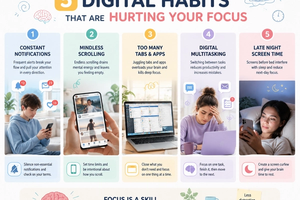
5 Digital Habits That Are Hurting Your Focus
Staying focused has become increasingly difficult in a world filled with constant notifications, endless scrolling, and nonstop digital stimulation. While technology offers convenience and connection, certain online habits can quietly damage attention spans, productivity, and mental clarity over time.
Many people don’t realize how deeply their daily digital behaviors affect their ability to concentrate. From multitasking across apps to checking notifications every few minutes, these habits train the brain to constantly seek distraction.
Here are five common digital habits that may be hurting your focus more than you think.
Key Takeaways
- Constant digital interruptions reduce attention span and productivity.
- Multitasking online often decreases efficiency rather than improving it.
- Social media scrolling can overstimulate the brain and increase distraction.
- Notifications condition the brain to expect constant stimulation.
- Small changes in digital behavior can significantly improve concentration.
1. Constantly Checking Notifications
One of the biggest focus killers is the habit of checking notifications the moment they appear. Whether it’s a text message, social media alert, or email notification, each interruption breaks concentration and forces the brain to refocus repeatedly.
Even brief distractions can reduce productivity because the brain needs time to fully return to the original task. Over time, constant interruptions train the mind to stay in a reactive state rather than a deeply focused one.
Many people also begin checking their phones compulsively, even without receiving notifications, simply out of habit.
2. Multitasking Across Multiple Screens
Watching videos while answering emails, scrolling social media during meetings, or switching between dozens of browser tabs may feel productive, but multitasking often reduces efficiency.
The brain is not designed to handle multiple cognitively demanding tasks at once. Instead, it rapidly switches attention between activities, which increases mental fatigue and decreases performance.
Frequent task-switching can also weaken the ability to focus deeply for extended periods, making even simple tasks feel mentally exhausting.
3. Endless Social Media Scrolling
Social media platforms are specifically designed to keep users engaged for as long as possible. Infinite scrolling, short-form videos, and algorithm-driven feeds constantly deliver new stimulation, making it difficult for the brain to slow down.
This endless stream of content conditions the mind to expect quick bursts of entertainment and novelty. As a result, activities that require patience and sustained concentration, like reading, studying, or working, may start to feel harder over time.
Many users also lose track of time while scrolling, turning a quick check into hours of passive consumption.
4. Keeping Too Many Tabs Open
Having dozens of browser tabs open at once has become surprisingly common, but it can create mental clutter and reduce focus. Even when not actively using them, open tabs compete for attention and create a constant sense of unfinished tasks.
This digital overload can increase stress and make it harder to prioritize important work. The brain remains partially aware of all the pending information, which contributes to mental fatigue.
Simplifying digital workspaces and focusing on fewer tasks at a time can help improve concentration and reduce cognitive overload.
5. Consuming Content Nonstop
Many people rarely allow their minds to rest. Podcasts during commutes, videos during meals, music while working, and social media before bed create a constant stream of stimulation throughout the day.
While entertainment itself isn’t harmful, nonstop content consumption leaves little room for reflection, creativity, or mental recovery. The brain needs periods of quiet and boredom to process information and recharge.
Without those moments, people may feel mentally overwhelmed, distracted, and unable to sustain attention for long periods.
Conclusion
Technology itself is not the enemy of focus, but certain digital habits can gradually weaken attention spans and make concentration more difficult. Constant notifications, endless scrolling, multitasking, and nonstop stimulation train the brain to crave distraction instead of deep focus.
The good news is that even small changes, like turning off notifications, limiting screen time, or creating distraction-free work periods, can make a significant difference.
In a world designed to compete for attention, protecting your focus has become one of the most valuable skills you can develop.