5 Industries Being Transformed by AI Right Now
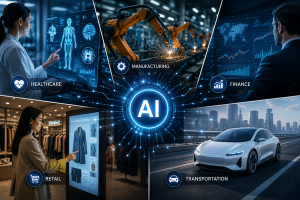
Artificial intelligence is no longer a futuristic concept, it’s actively reshaping industries across the globe. From how we receive healthcare to how we shop online, AI is driving efficiency, personalization, and entirely new ways of operating. Businesses that embrace these changes are gaining a competitive edge, while those that lag behind risk becoming obsolete.
Here’s a closer look at five industries undergoing rapid transformation thanks to AI, and what that means for the future.
Key Takeaways
- AI is revolutionizing decision-making through data-driven insights.
- Automation is reducing costs and increasing efficiency across sectors.
- Personalization is becoming the standard in customer-facing industries.
- AI tools are augmenting, not replacing, human expertise in many fields.
- Industries that adopt AI early are seeing significant competitive advantages.
Healthcare: Smarter Diagnosis and Personalized Treatment
AI is dramatically improving the way healthcare professionals diagnose and treat patients. Machine learning algorithms can analyze vast amounts of medical data—far beyond human capability—to detect patterns and predict outcomes.
For example, AI-powered imaging tools can identify early signs of diseases like cancer with remarkable accuracy. Meanwhile, predictive analytics help doctors tailor treatments based on individual patient histories, genetics, and lifestyle factors.
Beyond diagnostics, AI is also streamlining administrative tasks such as patient scheduling and record management, allowing healthcare providers to focus more on patient care. The result is faster diagnoses, more precise treatments, and improved patient outcomes.
Finance: Real-Time Decisions and Fraud Prevention
The financial industry has embraced AI as a core component of its operations. From algorithmic trading to fraud detection, AI is enabling faster and more accurate decision-making.
Banks and fintech companies use AI to monitor transactions in real time, identifying suspicious activity instantly. This significantly reduces fraud and enhances security for customers. At the same time, AI-driven credit scoring models are expanding access to financial services by evaluating borrowers more holistically.
Robo-advisors are another major shift, offering automated investment advice tailored to individual risk profiles and goals. These tools make financial planning more accessible, especially for those who may not have previously worked with human advisors.
Retail: Hyper-Personalized Shopping Experiences
AI is redefining how consumers shop—both online and in physical stores. Retailers are leveraging AI to analyze customer behavior, preferences, and purchase history to deliver highly personalized experiences.
Recommendation engines, like those used by major e-commerce platforms, suggest products based on past interactions, increasing both customer satisfaction and sales. AI also powers dynamic pricing, adjusting product costs in real time based on demand, competition, and market conditions.
In physical retail, AI-driven technologies such as smart shelves and cashier-less stores are enhancing convenience. Inventory management systems powered by AI ensure that products are always in stock, reducing waste and improving efficiency.
Education: Adaptive Learning and Intelligent Support
Education is becoming more personalized and accessible благодаря AI. Traditional one-size-fits-all approaches are being replaced with adaptive learning systems that tailor content to each student’s pace and learning style.
AI-powered platforms can identify where students struggle and adjust lessons accordingly, providing targeted support. Virtual tutors and chatbots are also available 24/7, helping students with questions and reinforcing learning outside the classroom.
For educators, AI tools assist with grading, curriculum planning, and performance analysis, freeing up time for more meaningful interaction with students. This shift is helping create a more engaging and effective learning environment.
Media & Content Creation: Faster, Smarter Creativity
AI is transforming how content is created, edited, and distributed. From writing articles to producing videos, AI tools are enabling creators to work faster and more efficiently.
For instance, AI can generate scripts, edit footage, and even create realistic avatars for video production. Tools like those used in AI video creation platforms simplify complex processes, making high-quality content accessible to a wider audience.
Additionally, AI is being used to analyze audience engagement, helping creators understand what resonates and optimize future content. This data-driven approach is changing the creative process, blending artistry with analytics.
Conclusion
Artificial intelligence is not just enhancing industries—it’s redefining them. From healthcare and finance to retail, education, and media, AI is driving innovation at an unprecedented pace.
What’s most striking is not just the efficiency gains, but the shift toward more personalized, data-driven experiences. As AI continues to evolve, its impact will only deepen, creating new opportunities and challenges across every sector.
Organizations that understand and adopt AI strategically will shape the future—while those that don’t may find themselves struggling to keep up.