How Noise-Canceling Headphones Work
Noise-canceling headphones have become incredibly popular among travelers, students, remote workers, and music lovers looking to escape distracting environments. Whether on airplanes, in busy cafes, or inside crowded offices, these headphones create a quieter listening experience that feels almost magical.
But despite how common they’ve become, many people still don’t fully understand how noise cancellation actually works. The technology behind it is surprisingly clever, using sound itself to eliminate unwanted noise.
Key Takeaways
- Noise-canceling headphones reduce unwanted background sounds using special microphones and sound waves.
- Active noise cancellation works best for constant low-frequency sounds like airplane engines or traffic.
- Passive noise isolation and active noise cancellation are different technologies.
- Modern headphones use advanced processors to adjust noise cancellation in real time.
- Noise-canceling technology improves focus, comfort, and listening quality.
The Difference Between Noise Isolation and Noise Cancellation
Many people confuse noise isolation with noise cancellation, but they are not the same thing.
Noise isolation simply blocks sound physically. Thick ear cushions or tightly sealed earbuds prevent outside noise from entering your ears, similar to how earplugs work.
Noise cancellation, on the other hand, uses electronic technology to actively reduce external sounds. This is why noise-canceling headphones can make environments suddenly feel quieter even without music playing.
Most premium headphones actually combine both methods for better overall performance.
How Active Noise Cancellation Works
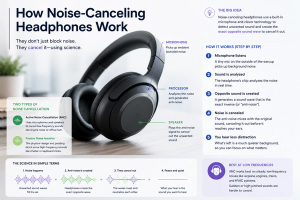
The core idea behind active noise cancellation is surprisingly scientific: headphones create sound waves that cancel out other sound waves.
Here’s how it works:
Tiny microphones placed inside or outside the headphones constantly listen to surrounding noise. The headphones then analyze those sounds and instantly generate an opposite sound wave, known as an “anti-noise” signal.
When the original sound wave and the anti-noise wave meet, they cancel each other out through a process called destructive interference.
As a result, the unwanted background noise becomes dramatically quieter before it even reaches your ears.
Why Noise Cancellation Works Better for Some Sounds
Noise-canceling headphones are especially effective against steady, predictable low-frequency sounds. This includes:
- Airplane engines
- Train noise
- Air conditioners
- Traffic hum
- Office ventilation systems
These sounds are easier for the headphones to predict and cancel in real time.
Sudden or irregular noises — like people talking, dogs barking, or babies crying — are harder to eliminate completely because they change too quickly and unpredictably.
That’s why even the best noise-canceling headphones don’t create total silence.
The Role of Digital Processors
Modern noise-canceling headphones rely heavily on tiny built-in computers called digital signal processors (DSPs). These processors analyze environmental sounds thousands of times per second and continuously adjust the anti-noise signal.
More advanced headphones can even adapt automatically to different environments. For example, some models increase cancellation strength on airplanes while reducing it slightly when walking outdoors for safety reasons.
Premium headphones also use artificial intelligence and machine learning to improve sound filtering and voice detection.
Do Noise-Canceling Headphones Affect Audio Quality?
Early generations of noise-canceling headphones sometimes reduced sound quality because the technology interfered with music playback. Modern models, however, have improved dramatically.
Today’s high-end headphones balance noise cancellation with rich audio performance, allowing listeners to hear music more clearly without needing extremely high volume levels.
In fact, many people find that reducing background noise actually improves audio clarity because external distractions are minimized.
Why People Love Noise-Canceling Headphones
One major reason noise-canceling headphones became so popular is that they reduce listening fatigue. Constant background noise forces the brain to work harder processing distractions, especially in noisy environments.
By reducing unwanted sounds, these headphones help people focus, relax, study, travel more comfortably, and enjoy music without constantly raising the volume.
For remote workers and students especially, they’ve become essential productivity tools.
Conclusion
Noise-canceling headphones may seem futuristic, but the science behind them is based on a surprisingly elegant concept: using sound to fight sound.
By combining microphones, digital processors, and anti-noise signals, these devices create quieter and more immersive listening experiences in noisy environments. While they can’t eliminate every sound completely, modern noise-canceling technology has become remarkably effective.
As audio technology continues evolving, noise cancellation will likely become even smarter, more adaptive, and more deeply integrated into everyday life.